When the event comes, your people are already covered — or they aren't.
Cover Our People is a complete preparedness system — physical kits, printed household playbooks, shelter and health layers, and department rollout training — built for the full range of confirmed threats: extreme heat, flood, freeze, wildfire smoke, water and power failure, disease, displacement, and fallout shelter-in-place. Configure it yourself, by region, department, and headcount, and see the licensing and production numbers before anyone has to sell you anything.
Sold by Astute Innovations Global and She Sees Colors Press. Production & marketing by She Sees Colors Press, which produces the actual content. Content authored by Ebony Innovates.
This page is for organizations — companies, governments, churches, and institutions covering their people in bulk. Covering your own household instead? The household side lives at i-life.world.
For procurement officersTwo contract models, transparent planning rates, volume tiers, and terms you can take straight into a sourcing file.
For HR & people teamsCover people by department, site, and headcount — one location or spread across the world — and generate the headcount summary your file needs.
One system. Every layer answers a named threat.
No partial kits and no gaps to explain later. Each threat in the configurator maps to a layer of the system, and your estimate shows exactly which layers you selected — and how each one is delivered.
10threat categories
9world regions
5system layers
3delivery models
The path — plain and simple
Four steps, in order. No gap in between.
Preparedness is built one step at a time, and each step includes the one before it — so the people you cover never face a jump they cannot make. Here is the whole path at a glance:
Step 1
72 Hours
The first 3 days
Water, food, light, warmth, first aid, and a household plan — enough for every person to get through the first three days of an event on their own.
Step 2
14-Day Preparedness
Two full weeks
The 99 Critical Stockpile and the household playbooks stretch that cover to fourteen days — stored food, water, medicine, and power, sized for real households.
Step 3
30-Day Challenge
One steady month
Thirty days of small, steady readiness — one step a day, with bonus drills — so the habits are in place before the season tests them.
Free gift — never sold
Step 4
90-Day Standard
The full standard
Ninety days of cover: the complete system — kits, books, shelter and health layers — so your people are covered for a full season, not just a weekend.
72 hours → 14 days → 30 days → 90 days. That is the whole ladder — nothing missing in the middle. The 30-Day Challenge is a free gift: it carries no price, and it is never sold.
The threats — and the layer that answers each one
Built against the forecast, not against a guess
The threat picture is drawn from official forecasting — including NOAA's El Niño outlook running well into 2027, the weakening Atlantic circulation (AMOC) and its cold-blob effect on the Gulf and Atlantic coasts, and the fallout planning that an ongoing war makes impossible to ignore. In the calculator, you select the threats confirmed for your regions — or only the ones you choose.
See the global forecast picture →— explore the full research picture first: pick your country, see every confirmed threat and the data behind it, continent by continent, then come back here ready to cover your people.
The system
Five layers, one standard of coverage
Every engagement — licensed or produced by us — is assembled from the same five layers. Mix them freely: license the kits for one department, have us produce the books for another, take everything for a third. The calculator prices each layer by the delivery model you pick for it.
01
Physical Preparedness Kits
The core 72-hour household kit plus the climate, health, and shelter-in-place modules your selected threats call for.
02
Books, Guides & Household Playbooks
Printed, plain-language guides households actually keep — per threat, per region, in your languages, under your brand if you white-label.
03
Training & Department Rollout
Train-the-trainer and department-by-department rollout support so distribution day is orderly — HR and emergency management get a plan, not a pallet.
04
Digital Platform & Updates
Coverage registry by department and location, threat updates as forecasts change, and re-order / refresh tracking for expiring components.
05
Shelter & Housing Sets
Stackable shelter and housing layers for displaced households — the piece most partial kits leave out entirely.
The library — real books, in full color
An actual library of books — not a list of titles
These are the real covers of books already written and designed in full color — the library that stands behind the kits and playbooks in this system. Organizations license them or order them in bulk for their people, printed or digital, in the editions and languages they need.
Buying for your own household instead? These books for your own home live on the household side, at i-life.world — this page is for organizations covering their people.
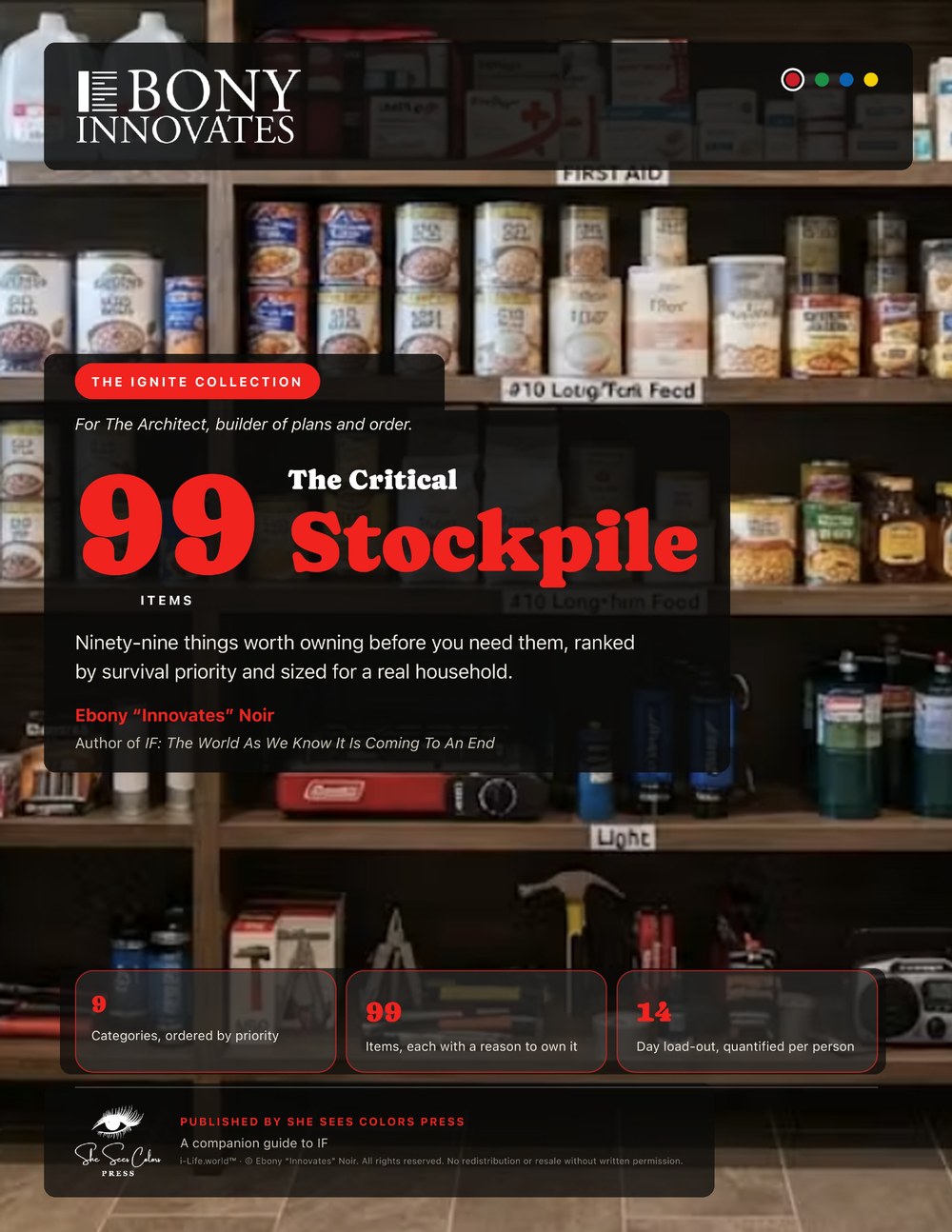
The 99 Critical Stockpile99 things worth owning before you need them, ranked by survival priority and sized for a real household — the 14-day load-out.30-Day Stewardship Preparedness ChallengeStep 3 on the path: thirty days of small, steady readiness, one day at a time, with bonus drills.Your organization receives a shareable link for the challenge, so the families connected to you can pass it on to their own families — that link is how families get the challenge through your organization.Free gift
The same books, with your name on them
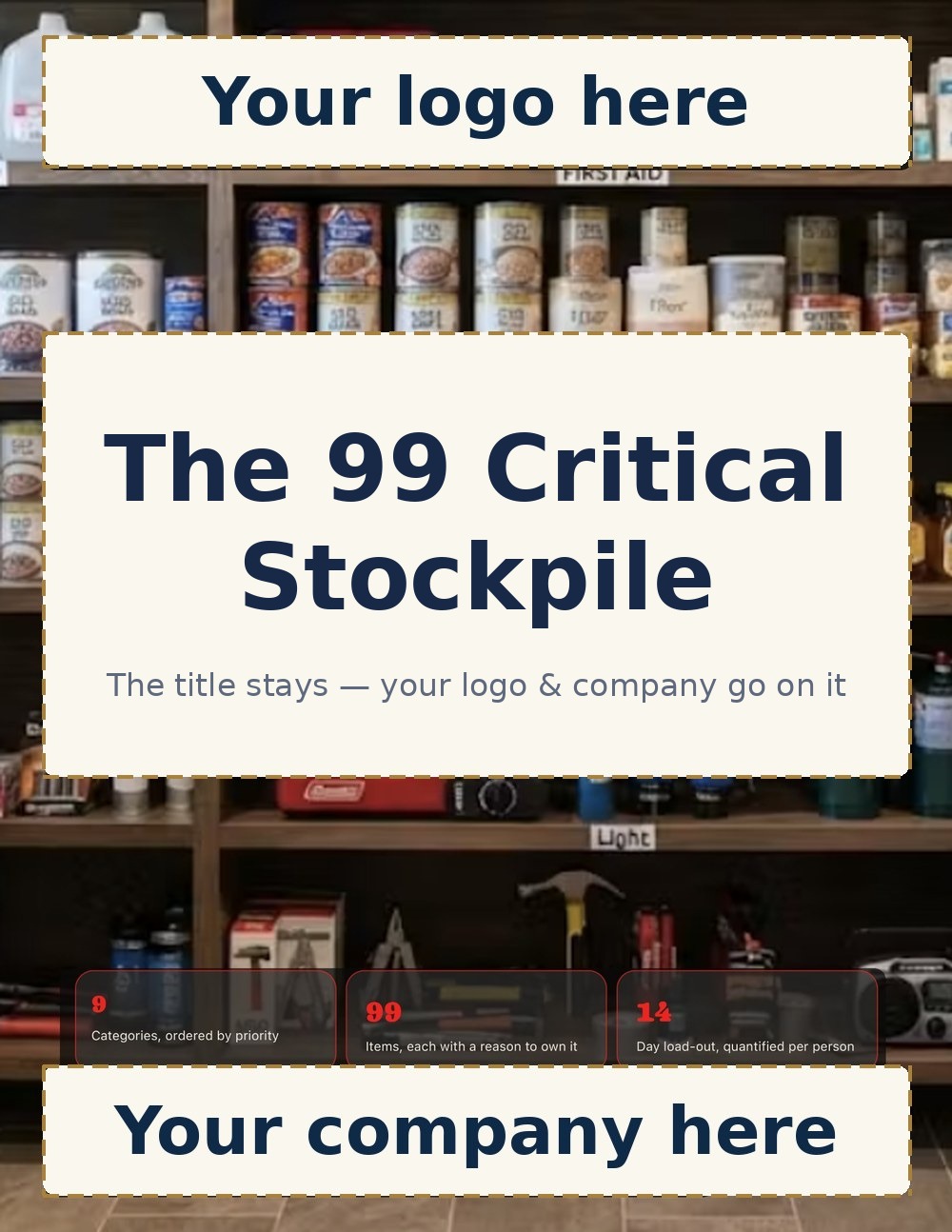
Under the white-label license (Model A) or co-branded production (Model B), the same full-color artwork goes out with your branding where ours sits now. The pair below shows the book twice — as published, and blanked ready for your logo and your company name. The title does not change: it stays The 99 Critical Stockpile, so nobody has to come up with a new one — only your logo and your company name go on it. Tick “White label — our brand only” in Step 5 of the calculator to put your brand on the books in your configuration.
The 99 Critical Stockpile
As publishedYour white-label version
For procurement — the two contract models
License it and produce it yourselves, or we produce it for you
Both models deliver the same system to the same specification. The difference is whose production line, whose print run, and whose brand is on the box. Most large buyers mix the two — and the calculator is built for exactly that.
Model A
License — Your Production (White Label)
You license the system and produce it under your own name, through your existing suppliers and print contracts.
You getFull specifications, artwork and print files, content, and quality standards for every licensed layer
BrandingYours — white label. Our name does not appear on product
ProductionYours, to spec, with audit rights to protect the standard
Cost shapePlatform license + per-person license per layer; you carry unit production cost
Best forGovernments and large employers with established supply chains and print capacity
TermDefined territory (your regions), defined departments, renewable term
Model B
Produced for You
She Sees Colors Press — production & marketing — manufactures, prints, assembles, and delivers finished product in bulk to your sites, ready for your team to distribute. Sold under Astute Innovations Global and She Sees Colors Press.
You getFinished kits, books, and sets delivered per site and department schedule
BrandingYours, ours, or co-branded — your choice per layer
ProductionOurs, to the same specification and quality standard
Cost shapePer-person / per-household unit pricing with volume tiers; logistics setup per region
Best forBuyers who need coverage in place on a deadline without standing up production
TermDelivery schedule and refresh cycle written into the order
Model C
Hybrid — Mix & Match
We produce the first rollout so people are covered now; you license and take over production for scale and refresh.
You getImmediate produced coverage plus the full license package
BrandingConsistent under your brand across both phases
ProductionOurs first, yours ongoing — handover and training included
Cost shapeLicense + produced pricing on the initial cohort (calculator models 60% of produced volume)
Best forMulti-region and multi-department rollouts that cannot wait for a production line
TermPhased schedule agreed department by department
License scope is always explicit: named regions, named departments, named layers. A license for one department does not extend to another, and white-label use outside the licensed scope is not permitted. Final terms, specifications, and pricing are confirmed in a written proposal for your configuration — the calculator's planning rates below are for budgeting and comparison, not a quote.
Special editions
Translated editions for global teams — and Cover God's People, the Church Edition completed in Scripture
Two options buyers asked for, built into the configurator below. Note either one in Step 5 and it is written into your configuration, board brief, and purchase order.
For international organizations
Multi-language, limited-stock translated editions
If your people are spread across countries and speak other languages, you do not have to settle for English only. Note the titles / issues and the quantities you want translated, and we produce them as limited-stock runs in those languages.
How it worksYou name the languages, the items, and the quantity per language in the calculator
StockTranslated physical stock is produced in limited quantities per language — reserve the quantity you need in your order
Best forMultinational employers, agencies, NGOs, and denominations with people in multiple regions
Confirmed inYour written proposal — languages, titles, quantities, and schedule per language
For churches & faith organizations
Cover God's People — the Church Edition
The Church Edition has a name of its own: Cover God's People. It is not the standard edition with a verse added. It is fully completed with scriptures throughout — the hundreds of scriptures on wisdom, prudence, preparing in advance, stewardship, leadership, and covering your flock — this teaching manifested, made whole, in a preparedness system your congregation can actually use.
Woven throughoutScripture on wisdom & prudence, preparation, stewardship, and leadership — not an insert
Covering your flockWritten for pastors, trustees, and ministry leaders carrying care for their people
Same systemAll five layers, configured by household and ministry group like any other buyer
Select itTick “Cover God's People (Church Edition)” in Step 5 of the calculator
Accessible formats — on request
The same content, in the format each person can actually use
A translated edition only helps if a person can read it. The content can also be produced in the format each person can actually use — note the formats your people need, the same way you note languages, and they are priced in your written proposal.
Braille editionsPrinted in Braille for people who read by touch
A children's versionThe same guidance, written and laid out simply for children
Easy-read editionsShort sentences, plain words, and clear pictures for people who need reading made easier
Audio editionsThe content read aloud, so a person can listen instead of read
Sign-language videoThe content signed on video for people who sign
Already done elsewherePoland distributes Braille editions and a children's version, Norway distributes easy-read editions and sign-language video, and Ireland distributes audio editions through the post
How it worksYour organization notes the formats and quantities it needs; formats, quantities, and schedule are confirmed and priced in your written proposal
Distribution — read this before you order
We deliver in bulk to you. Your organization owns the last mile.
Cover Our People is not sold with individual distribution. We do not ship kits or books person-by-person to home addresses as a standard offer — your organization receives bulk delivery at your sites and distributes to your own people through your own channels. What can reach individuals directly is the small, digital layer — by email and by download.
Bulk delivery — the standard
Finished kits, books, and sets are delivered per site and per department, on the schedule in your agreement.
Your HR, emergency management, ministry, or site teams handle hand-out to individuals — with the rollout training and coverage registry we provide.
This keeps cost, address data, and accountability where they belong: inside your organization.
Individual reach — by email & download only
The smaller pieces are made for individual distribution:
The Critical One Sheet / critical checklist and the First 72 starter guide — small, printable, and email-ready.
You send us a spreadsheet (Excel / CSV) of your people's email addresses, and we email each person what they are supposed to get.
Files are downloadable on their end, so each employee or member can save and print their own copy.
Exception, priced as an exception: if an organization truly requires full individual physical distribution, it is arranged only as a special premium engagement and priced accordingly — it is never the standard offer and is confirmed separately in writing.
For the duty-of-care seat
The case to take upstairs
This decision usually starts with the person who carries duty of care — the CHRO or people leader, the COO, the risk and business-continuity lead; in government, the agency head, the city or county leader, the emergency management director; in a church, the senior pastor and trustee board. Procurement executes the contract and the CEO or CFO approves above threshold — but the question that starts it is yours, and after an event it will be asked of your seat directly: what did we do to prepare our people? This section is written so you can carry the answer into that room.
Duty of care
"We knew the forecast. What did we put in our people's hands?"
Employers, agencies, and faith communities all carry a recognized duty of care for the people in their charge. That duty is judged after the event, against what was known before it. The forecasts behind this system are public and official — which means "we didn't know" is not an available answer. A documented, distributed preparedness program is the evidence that the duty was met.
The cost of waiting
"Preparedness bought in a crisis costs more and arrives less."
In an active event, every buyer competes for the same stock, freight, and print capacity at the same time — lead times stretch exactly when days matter.
Spot purchasing in a crisis carries crisis pricing; contracted volume pricing is set in calm weather.
Distribution without a prior rollout plan is the failure point in most post-event reviews — not the product, the absence of a plan.
Coverage put in place before an event is a budget line. Recovery after one is an emergency appropriation.
Stewardship
"Caring for the people entrusted to us is the job — before the storm, not after."
For a trustee board or a council, this is stewardship of people and of funds: a per-person cost you can state in one sentence, weighed against the human and financial cost of a workforce or a congregation caught unprepared. The configuration below gives you that sentence — your people, your regions, your number — ready to say out loud in the room where it gets approved.
Generate your board brief
Configure your coverage in the calculator below, then generate a one-page brief in duty-of-care language — your scope, your estimate, and the case — ready to download and take to the CEO, CFO, council, or board.
Your brief will appear here once generated. It uses the live numbers from your configuration — regions, departments, headcount, delivery model, and planning estimate.
The coverage calculator
Build your coverage — region by region, department by department
Answer the questions in order. Your estimate updates as you play with it. Choose everything, or only this for that department and only that for this region — the mix is the point. At the end, the calculator hands you back a purchase order you built yourself — line items, totals, and all — ready to hand straight into your own approval chain.
1
Who is configuring this?
The flow is the same either way — this just sets the language of your summary and the file it generates.
2
Where are your people?
One site, or spread across the world? Select every region where you have people, and enter the headcount in each. Your total builds itself.
Region headcounts entered so far: 0. If they add up to more than the total, the region sum is used.
3
Which departments and groups are covered?
Tap every department or group in scope. License scope and rollout are defined per department — you can license for some and have us produce for others in Step 5.
4
What are you covering them for?
Start from what is confirmed for your regions, then add or remove freely — only this, only that, or everything.
5
Mix & match: license, produced by us, or both — per layer
Each layer is priced by the delivery model you choose for it. License the kits, have us produce the books, take everything for one layer and nothing for another.
Order the quantity you need per language while that language run is available. If a run sells through, the next run is scheduled in your proposal.
You supply the address list as a spreadsheet after the proposal is confirmed. We do not collect your people's addresses through this page.
Purchase Order — Draft
Built by the buyer at coverourpeople.com · Vendor: Astute Innovations Global and She Sees Colors Press — Cover Our People program Production & marketing: She Sees Colors Press · Content authored by Ebony Innovates
PO date:—
Status: Draft — for your approval chain
Model:—
Buyer
Complete Step 1 and your organization details appear here.
Coverage scope
Your regions, departments, headcount, and threats appear here as you configure.
Item — layer & delivery model
Unit rate
Qty
Amount
Subtotal (planning rates)
—
Estimated order range
—
Per person covered
—
Next step: send this purchase order to hello@ebonyinnovates.com. You will receive a written proposal confirming final pricing, specifications, license scope, translated quantities (if selected), Cover God's People / Church Edition (if selected), and bulk delivery schedule for this exact configuration — then it enters production or licensing on your approval. Physical product is bulk-delivered to your sites; your organization distributes to individuals. Small digital pieces can be emailed individually when that option is selected and you supply the address spreadsheet.
Print this sheet from your browser or save the download — it is formatted to hand straight into a procurement approval chain. Amounts are planning estimates from the published rate structure, not a binding quote; the written proposal confirms the final figures.
Who pays — and from which money
The buyer is not always the funder
The seat that champions coverage is often not the budget that pays for it. Use this map to find the money inside your own house — or in the house of a partner whose mission your people's preparedness already serves. This is general information to start the conversation, not eligibility advice: each organization's own counsel or grants officer confirms what a given fund may pay for.
Banks & financial institutions
Coverage for low- and moderate-income communities is commonly funded through community development and CRA community service budgets, and through bank foundations — preparedness for the communities a bank serves is community development work.
Insurers & utilities
Insurers and utilities sponsor risk reduction because preparation lowers their losses: a household that weathers the event files fewer claims, and a customer base that can shelter safely is a grid and a book of business that recovers faster.
Nonprofit hospitals
Community benefit spending exists to improve the health of the community a hospital serves — and a prepared community is measurably a healthier one when the heat, flood, or outage comes.
Employers
Companies cover their own people directly, as an employee benefit and a duty-of-care and business-continuity investment — funded from HR, risk, or continuity budgets rather than waiting for a sponsor.
Cities & counties
Emergency management budgets, and federal and state preparedness and mitigation grant money that flows through them, are the standard route for covering residents — often with a bank, utility, or foundation partner sharing the cost.
Schools & universities
Campus and district safety budgets fund coverage for students, staff, and the households around them, frequently alongside city and county emergency management.
Churches & denominations
Stewardship funds and disaster relief funds — held at the congregation level and at the denominational level — exist for exactly this: caring for the flock and the neighborhood before the disaster, not only after it.
Community foundations & United Way–style funders
Community foundations and United Way–style funders pool local money for local resilience and can underwrite coverage for the households no single buyer reaches on its own.
Housing authorities & property managers
Those who house people carry the duty for the people in their buildings — coverage for residents is funded as resident services and risk management, property by property or across a portfolio.
Where elected officials fit
Mayors, county judges, council members, and legislators appear in this picture as champions and conveners — the voices who point public budgets and grant programs at preparedness, convene the bank, the utility, the hospital, and the foundation at one table, and take the stewardship case to their constituents. Coverage is purchased by organizations through the funding paths above, through public budgets and grants — never through campaign funds, and this program does not seek campaign donations.
Funding routes above are described in general, informational terms. Eligibility, allowable costs, and compliance requirements differ by funder and jurisdiction — confirm your route with your own counsel, grants officer, or the funding program itself before relying on it.
Procurement path
From this page to people covered, in four steps
1
Configure
You build the scope here — regions, departments, threats, layers, delivery model per layer — and download the configuration.
2
Proposal
Send the configuration and receive a written proposal: confirmed pricing, specifications, license scope, and delivery schedule.
3
Agreement
License or production agreement executed — territory, departments, term, branding, and quality standard in writing.
4
Rollout
Bulk production and delivery to your sites, department by department, with training and the coverage registry handed over. Your team distributes to individuals; the Critical One Sheet and First 72 can go by email when you supply the address spreadsheet.
Questions procurement and HR ask first
Can we license for some departments and buy produced product for others?
Yes — that is the normal case. License scope is written per department and per layer, and produced orders run per department and site. The calculator models exactly that mix.
What does white label actually allow — and not allow?
A white-label license lets you produce the licensed layers under your own brand, to specification, within your licensed regions and departments, for the license term. It does not extend to unlicensed departments, regions, or layers, and product may not be resold outside the licensed scope. The full permitted-use schedule is in the licensing document that accompanies the proposal.
Our people are in several countries. Can one agreement cover them?
Yes. Regions are selected individually in the configuration, each with its own headcount and confirmed threat set, and the agreement schedules them together — including multi-language books and guides where selected.
Is the calculator's number our price?
No — it is a planning estimate built from published planning rates, shown as a range, so budget holders can compare license, produced, and hybrid shapes honestly. Your binding price is the written proposal for your exact configuration, quantities, and specifications.
We are a church, not a government or a company. Does this fit us?
Yes. Congregations configure the same way — households instead of headcount by department, trustee-board approval instead of a procurement file. Select Cover God's People — the Church Edition — in Step 5: it is fully completed with scriptures throughout, on wisdom, prudence, preparing in advance, stewardship, leadership, and covering your flock. The board brief generator above is written for that room as well.
Can we get editions in other languages?
Yes, as limited-stock translated editions. In Step 5, note the languages, the items / titles, and the quantity you need per language. Translated physical stock is produced in limited quantities per language and reserved in your order; the final languages, titles, quantities, and schedule are confirmed in the written proposal.
Do you deliver to each employee or member individually?
Not for physical product as a standard offer. Kits, books, and sets are bulk-delivered to your sites and departments, and your organization distributes to its own people. The exception is the small digital layer — the Critical One Sheet / checklist and the First 72 — which can be emailed individually: you send a spreadsheet (Excel / CSV) of email addresses, we email each person what they are to receive, and they download and print it on their end. Full individual physical distribution is available only as a special premium arrangement, priced separately.
Who is the vendor on our purchase order?
Cover Our People is sold under Astute Innovations Global together with She Sees Colors Press. She Sees Colors Press is production & marketing and produces the actual content. Ebony Innovates is credited as author of the content.
Ask about Cover Our PeopleQuick answers drawn from this page — the kit, pricing, editions, distribution, and funding. For a binding answer, request the written proposal.